
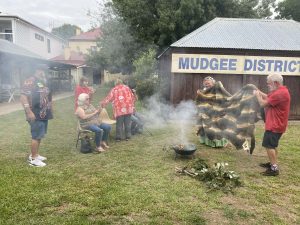
 On 8 March 2026 members of the Warrabinga Aboriginal Corporation delivered two Mowgee Possum Skin Cloaks to Mudgee Museum and installed them in a special purpose upright glass exhibition cabinet. One is a community cloak and the other is a cloak for a newborn infant. The installation was preceded by a smoking ceremony to cleanse the cloak before installation.
The large community cloak of 21 skins depicts the story of Emanjili, Diana Mudgee, a local Wiradjuri Mowgee woman, her life, country and her many descendants.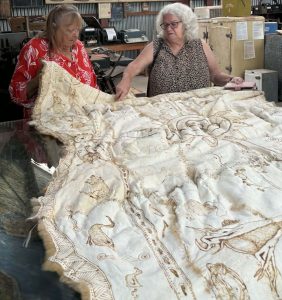
Diane Pirotta, an artist who is a possum skin cloak maker, tells us that the skins were fitted together, one tail up, one tail down so they lay flat and neat and were then sewn together with waxed thread and a wedged metal needle using traditional herringbone stitch. Community members were also involved in the initial stages, trying out their skill with the stitching, and descendants of Diana Mudgee produced drawings for inclusion in the artwork. These drawings are specific to the individual or their family so they alone would know their own story as recorded on the Cloak. Diane then incorporated these drawings into a final design and the stories were burnt into the cloak using a pyrography tool.
The infant’s cloak was made from two possum skins and also includes artwork created using a pyrography tool.
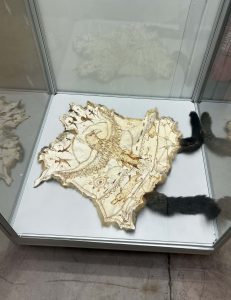
Traditionally possum skin cloaks were the first form of patchwork, sewn together by women using kangaroo sinew and a bone needle using a herringbone stitch. They were made and worn by Aboriginal people for two reasons. Firstly, they were made for warmth and protection from the weather and were waterproof as the rain runs off the fur as it does with the animal. The second use was ceremonial. A cloak was made from a single skin for a newborn baby with incisions on the underside recording kinship, totems, ceremonies and initiations and became an extension of that person with a new piece added for each significant life experience and they were eventually buried in it.
The Government Assimilation Policy in the 1800s discouraged cultural practices and forced Aboriginal people to use woollen blankets for warmth, and their issue was recorded in Blanket Lists. This resulted in a lot of sickness as the blankets were not as warm as skins and were not waterproof. There are only fifteen traditionally produced cloaks from the 1800s in museums around Australia. From the early 2000s there has been a resurgence in women learning their lost culture such as weaving, language, bush foods and medicines or possum skin cloak making, as it is no longer disallowed by the Government.
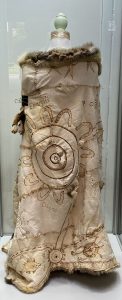 Mudgee Historical Society wishes to congratulate the Warrabinga Aboriginal Corporation and all its community members involved in the design, development and creation of this wonderful cloak. The Society wishes to thank the Board of Directors of Warrabinga, and its own members who were involved, for making all the arrangements necessary to bring this project to fruition.
Information was taken from notes provided by Diane Pirotta and Damien Kennedy of the Warrabinga Aboriginal Corporation.